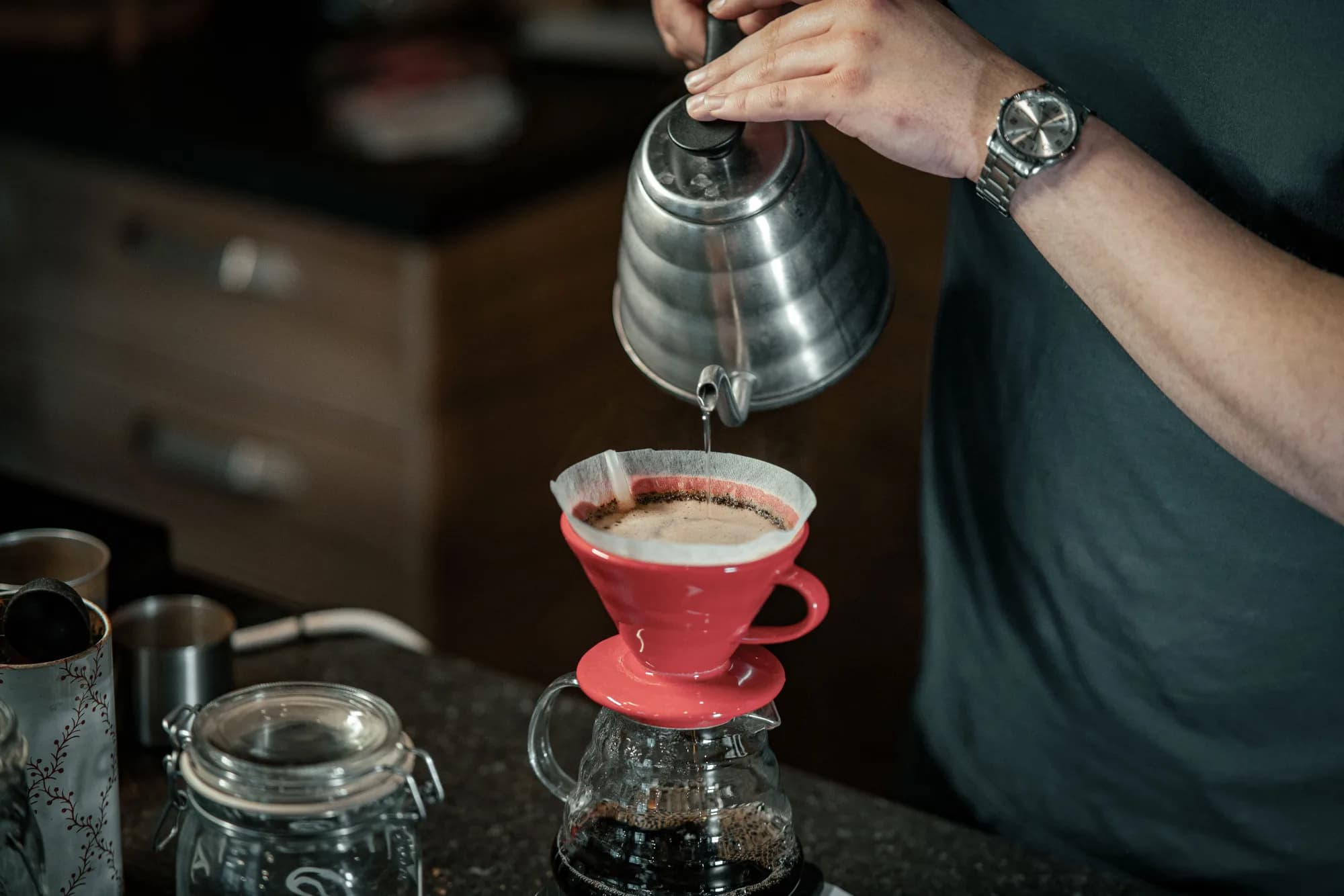
Filter coffee, brewed through a paper filter with a dripper like a V60 or Chemex, produces a clean, bright cup that shows a coffee's character clearly. The method is simple, but it rewards consistency more than most, small habits done the same way every time matter more than any single piece of equipment.
What you need
- A dripper (V60, Kalita or similar) and paper filters sized to it
- A kettle, ideally with a narrow spout for a controlled pour
- A scale
- Freshly ground coffee, medium-fine
The full process
Rinse the filter first. Run hot water through the paper filter before adding coffee, this removes any papery taste and preheats your dripper and cup.
Use a 1:16 ratio as a starting point. For every gram of coffee, use 16 grams of water. Adjust from there to taste, lower for stronger, higher for lighter.
Grind medium-fine, similar to table salt, and grind fresh immediately before brewing if you can.
Bloom first. Pour just enough water to saturate the grounds, roughly double the coffee's weight, and let it sit for 30 to 45 seconds. This releases trapped CO2 that would otherwise interfere with even extraction.
Pour in slow, controlled stages. After the bloom, pour the remaining water in two or three slow additions, moving in gentle circles, rather than dumping it all at once. This keeps the grounds bed saturated evenly throughout the brew.
Aim for a total brew time of 2.5 to 3.5 minutes. If you're finishing much faster, your grind is likely too coarse. Much slower, and it's probably too fine.
Water temperature: 90 to 96°C. Cooler tends to under-extract, hotter risks pulling out unwanted bitterness.
Troubleshooting
Sour, thin cup: under-extracted, grind finer or extend the brew time slightly.
Bitter, harsh cup: over-extracted, grind coarser or shorten the time.
Uneven or muddy: check your pour technique, a fast, uncontrolled pour disturbs the grounds bed and causes channelling.
The takeaway
Filter coffee is genuinely simple in principle: rinse the filter, bloom properly, pour slowly and consistently, and dial in ratio and grind from there. The method rewards repetition and small, deliberate adjustments far more than expensive equipment.