Turkish coffee is one of the oldest continuous coffee brewing traditions still practised today, recognised by UNESCO in 2013 as Intangible Cultural Heritage. The method is genuinely different from most Western brewing: ultra-fine grounds, unfiltered, brewed slowly rather than extracted quickly under pressure or through paper.
Why it tastes different
Because Turkish coffee is unfiltered, everything that a paper filter would normally catch stays in the cup, including the coffee's natural oils. The extremely fine, almost powder-like grind allows near-complete dissolution during the slow heating process, producing a texture and intensity that filtered methods simply don't replicate.
The traditional method
Ratio: roughly 1 part coffee to 9 or 10 parts water by weight, a notably stronger ratio than most filter or drip methods.
Grind: powder-fine, finer than espresso, this is essential to authentic Turkish coffee's distinctive body and isn't something a standard grinder always achieves without a dedicated fine setting.
Water: start with preheated water, around 60°C to 80°C, rather than cold water from the tap.
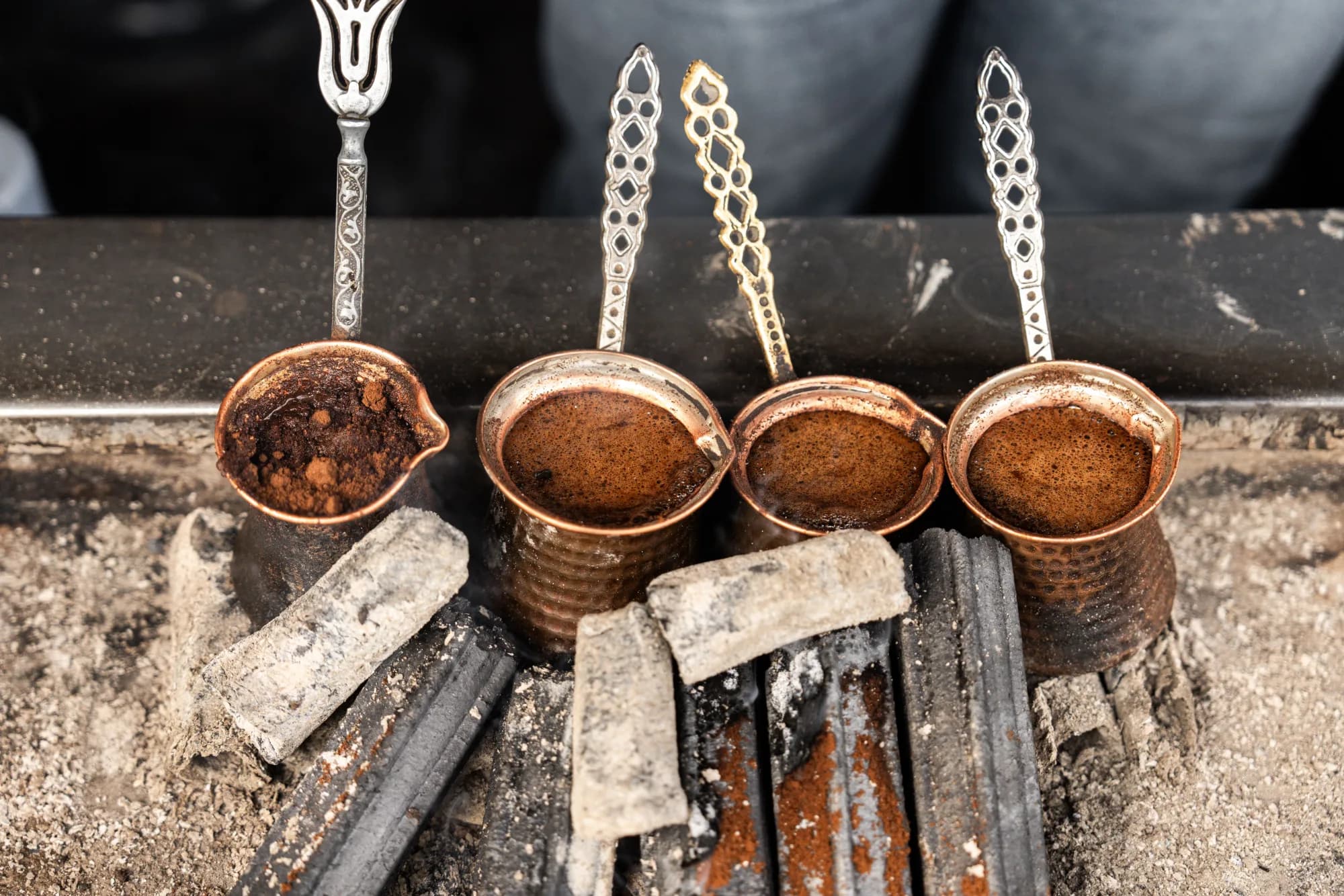
Heating: combine the finely ground coffee and water directly in a cezve, the traditional narrow-necked pot, and heat gently. Watch closely as foam builds and darkens, the goal is to catch it just before it comes to a full boil.
Choosing your beans
Medium roasts tend to work particularly well for Turkish coffee, and single-origin beans let the distinct character of a specific origin come through more clearly than a blend would, since the brewing method itself is already quite intense and concentrated.
A tradition worth respecting
Turkish coffee isn't just a brewing technique, it carries real cultural weight: the ritual of preparation, the shared serving, and the slow pace of drinking it are as much a part of the tradition as the method itself. Approaching it as a genuine cultural practice, not just another brewing gimmick, is part of doing it properly.
The takeaway
Turkish coffee rewards patience and precision in a way that's genuinely different from most modern brewing methods. Get the grind fine enough, watch the heat closely, and you get a coffee experience that's been refined over centuries, not a novelty.