One of our baristas makes up to 80 coffees an hour at an event. Put a second barista on the same cart and that pace doubles to 160 an hour, because one person can pull shots while the other textures milk. That is the number to plan around: take the guests you expect in your busiest window, compare it with what the cart can pour in that window, and add baristas or carts until the two match.
The rest of this post covers what that number assumes, what moves it, and how to use it for your own event.
What sits behind 80 an hour
Eighty coffees an hour is a sustained pace for one barista working a single cart with a commercial espresso machine. It is not a sprint figure. It holds across a long service because the cart is set up to remove every decision that slows a barista down.
A few things make it possible:
- One cup size. Every serve at our events is a standard 6oz. One size means one shot recipe and one jug fill, so the barista never stops to think about which cup a drink needs.
- A short menu. The classics, plus decaf and the full range of milks. Every extra item on a menu board is a pause at the front of the line.
- Everything within reach. Milk, cups and lids are stocked before service so the barista is not walking away from the machine mid-rush.
What 80 an hour does not mean is that a barista can clear 80 guests in the fifteen minutes after a keynote. The hourly figure is a rate. If half your room arrives at the cart in the same ten minutes, the line forms anyway, and the last person in it waits.
Two baristas, one cart
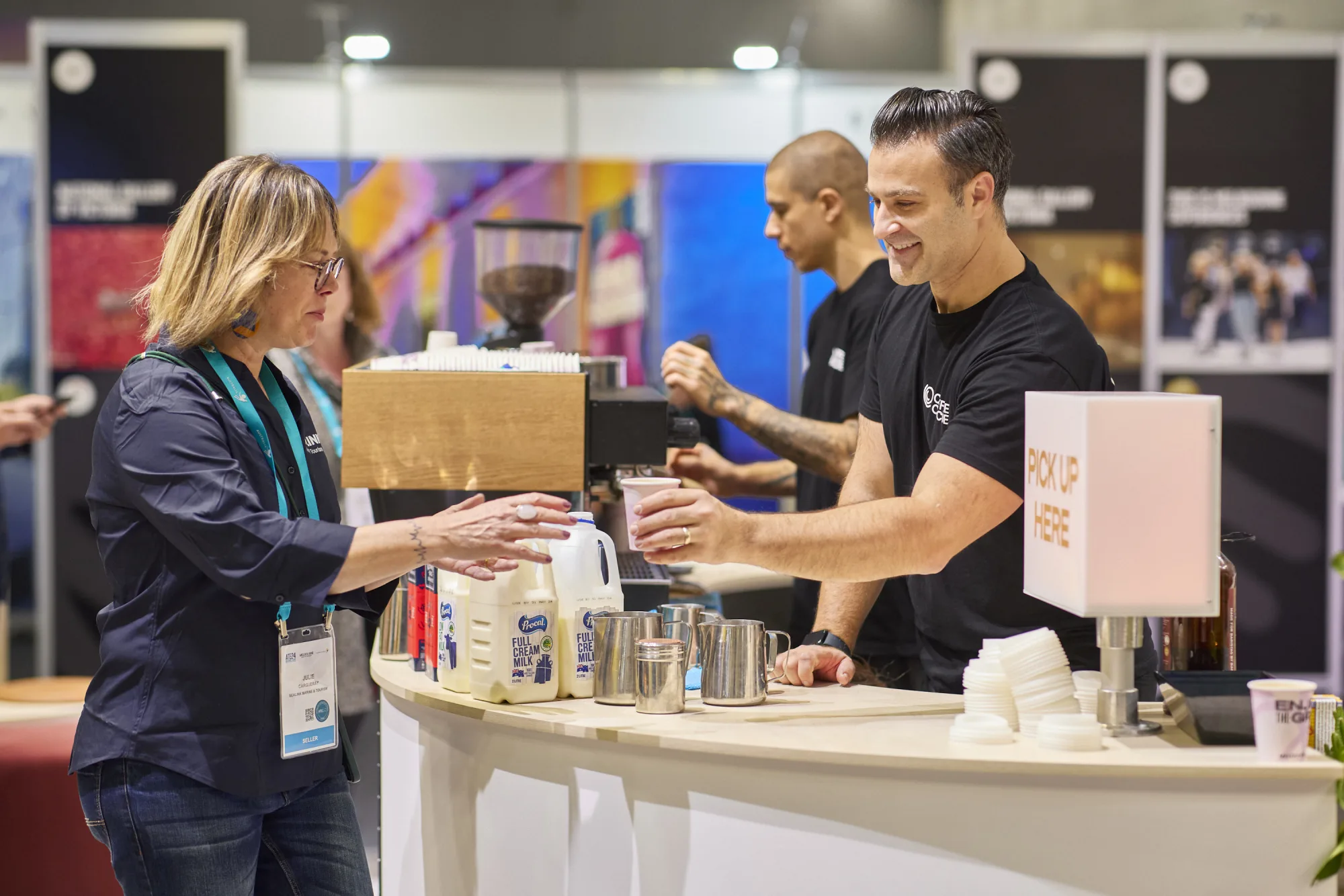
The fastest way to add capacity is a second barista on the same machine. One grinds, doses and pulls shots. The other steams milk and pours. Working together they reach up to 160 coffees an hour, double the pace of one, without a second cart.
That matters for planning in three ways:
- Cost. A second barista is $400 for a weekday half day or $800 for a full weekday, ex GST. A second cart is quoted as its own package.
- Space. Two baristas fit behind one cart, so you need one position and one queue, not two.
- Power. A standard cart needs two 10-amp sockets, or one 20-amp outlet for the larger cart, whether one barista works it or two. Plug the cart straight into the wall rather than a power board, as NT WorkSafe advises for high-current appliances. We carry our own water.
Past 160 an hour, extra hands on one machine stop helping, and the answer is a second cart in a second position. Three two-barista carts pour up to 480 an hour. Our post on how many coffee carts you need for 500 people works through that bigger decision with a table of common program shapes.
Working out your own number
Start with your run sheet, not your guest list.
- Find your busiest window. For most events it is arrival or the first break after a long session.
- Estimate how many guests will want a coffee in that window. Not everyone drinks coffee at every break, but at a morning event most of the room will.
- Work out what one barista pours in that window. At up to 80 an hour, a 30-minute break is a fraction of that hourly figure.
- Add a second barista, then a second cart, until the pour rate covers the demand.
For a sense of real volumes, a conference organiser we have partnered with since 2019 sees around 270 coffees at a typical conference and up to 700 at a dual summit, served from one to three carts. The full numbers are in our conference coffee case study.
If you would rather we did the working, send us the run sheet with your enquiry. Our coffee cart hire page has the packages, and the common booking questions are answered on our FAQ. For what keeps the hundredth cup as good as the first, see how baristas make consistent coffee for hundreds.
How we see it
The most common planning mistake we hear is not a wrong number. It is the assumption that one cart covers any crowd if the barista is good enough. A planner expecting several hundred guests across a single hour will sometimes ask whether one cart will do. Our honest answer is no, and we would rather say so at the quote than at the event.
That answer sometimes makes the quote bigger than the client expected. We still think it is the right one. Telling a client that one barista can keep up with a room that clearly needs three is how a premium service turns into a queue, and the guest at the back of that queue does not know or care whose fault it was.
So we ask about the break before we talk about the barista. How long is it? Does everyone leave through the same doors? Is registration open early enough to spread the demand? Those answers decide whether one barista is plenty, whether a second barista on the same cart is the smart addition, or whether you need another cart.
What our crews notice is that guests rarely remember how many coffees were made. They remember whether the break felt like a line or a conversation. Getting the barista count right is how you give them the second one.